This project explored how University of Michigan students use campus libraries to study, check out books, and navigate resources. My goal was to uncover pain points and opportunities to make the library experience more intuitive and supportive. I conducted user interviews, applied photo elicitation methods, and analyzed data through thematic coding to build a persona and storyboard based on real user insights.
Role: UX Researcher
Timeline: Fall 2025
Tools: Google Docs, Miro, Zoom, Figma
Methods: Semi-structured interviews, photo elicitation, thematic analysis
Identifying the problem
We were tasked with solving a problem that we had noticed students, or other demographics having. Something I am passionate about, is reading books and funding libraries. So, I developed my objective based off of that. My objective was: “I want to understand how the process of finding books to read can be challenging for college students because of lack of funds, time, or awareness of places to get them, and explore the opportunity to make this process more accessible, and thus improve their ability to read books for fun.”
Research
Research Plan
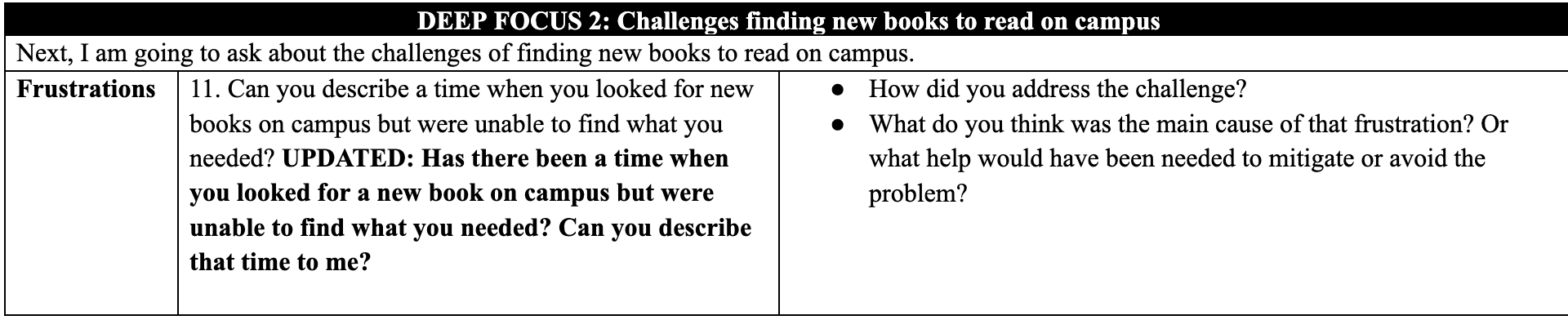
I first started out this project by fleshing out my interview topic and questions. I created a detailed interview guide to structure my sessions and encourage open, reflective discussion. My questions moved from general to specific, helping participants feel comfortable before exploring deeper experiences and challenges with the library system. I did this before the interview recruitment process so that I could select participants that would be the most relevant for my interview. I included questions in sections like “Warm-Up,” “General Issues,” “Deep Focus,” “Retrospective,” and “Wrap up.”
Consent and Recruitment
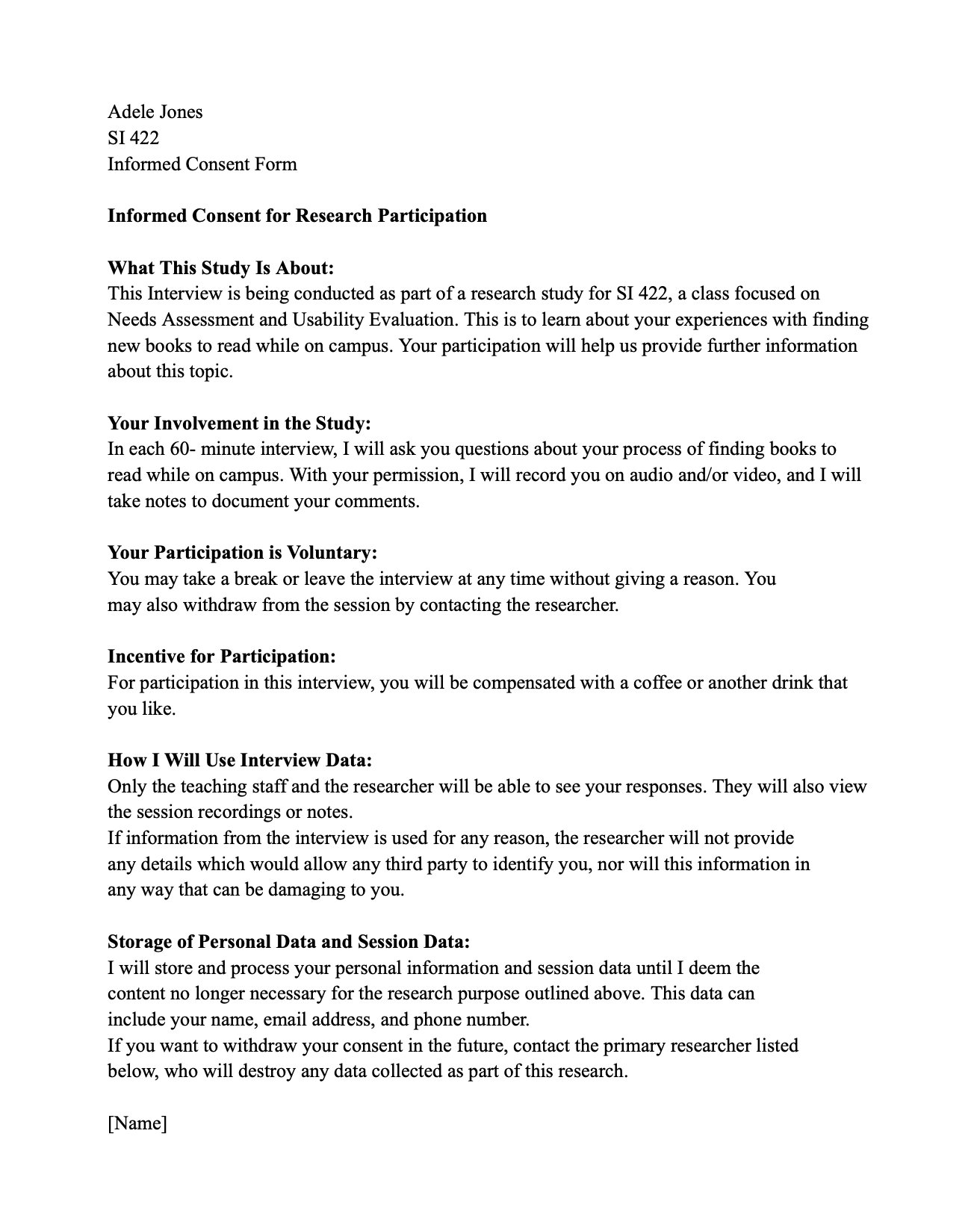
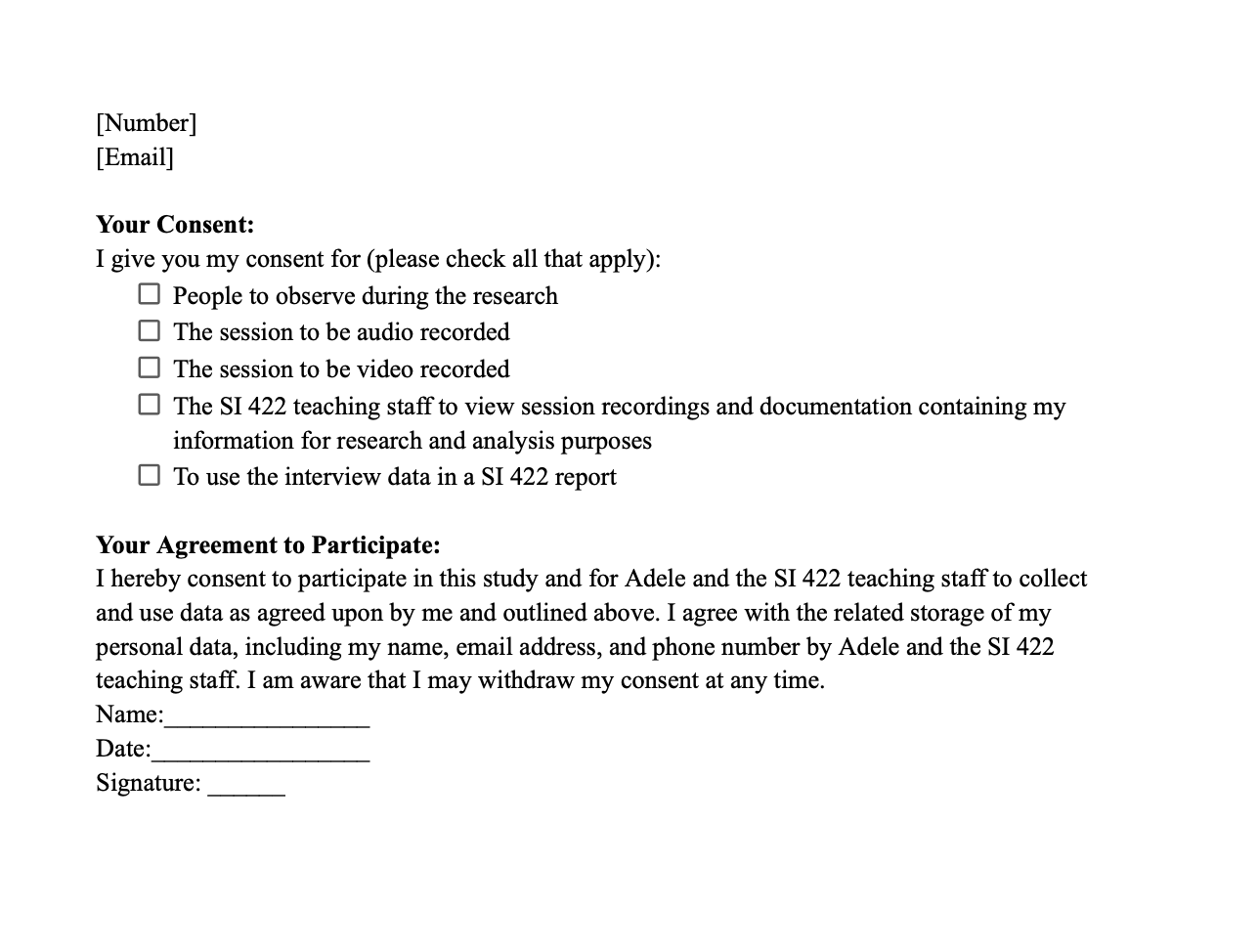
Before conducting interviews, I created a recruitment plan and pre-interview questions to ensure I included participants with diverse library experiences. I also developed a consent form to explain the purpose of the study, how data would be used, and to protect participants’ privacy.
Once I had finished the consent forms, I started reaching out to my possible participants, mostly via text. I approached each participant with this script: “Hi! I was wondering if you would be interested in participating in an interview for my SI422 class. This interview will be about 45-60 minutes long, and I will be asking you questions about your process for finding books on campus. The interview will help me to better understand how different college students think about the process of finding new books to read. We can either meet in person, or virtually, and we will schedule the interview based on your availability. I will buy you a coffee or other drink of your choice for during or after the interview.” If the people I reached out to agreed, then I screened them using this screener:
Do you like to read while at school?
Yes (included)
Only those who enjoy to read will truly care about my research/interview
No (excluded)
Do you attend U of M?
Yes (included)
I am only conducting the user research based off of U of M’s campus
No (excluded)
Do you read books online or physically?
This one I will decide to include participants based on the other participants answers. If every participant I chose read books online, it would skew the results, and not give me all the data I want, so I want participants who read books both ways, or a mix of participants.
Do you have a process to find books on campus?
Yes (included)
This is exactly related to my objective, if a participant does not have a solid process for finding books on campus, it will be difficult for me to interview them and get good responses.
No (excluded)
Activity Design and Pilot Testing
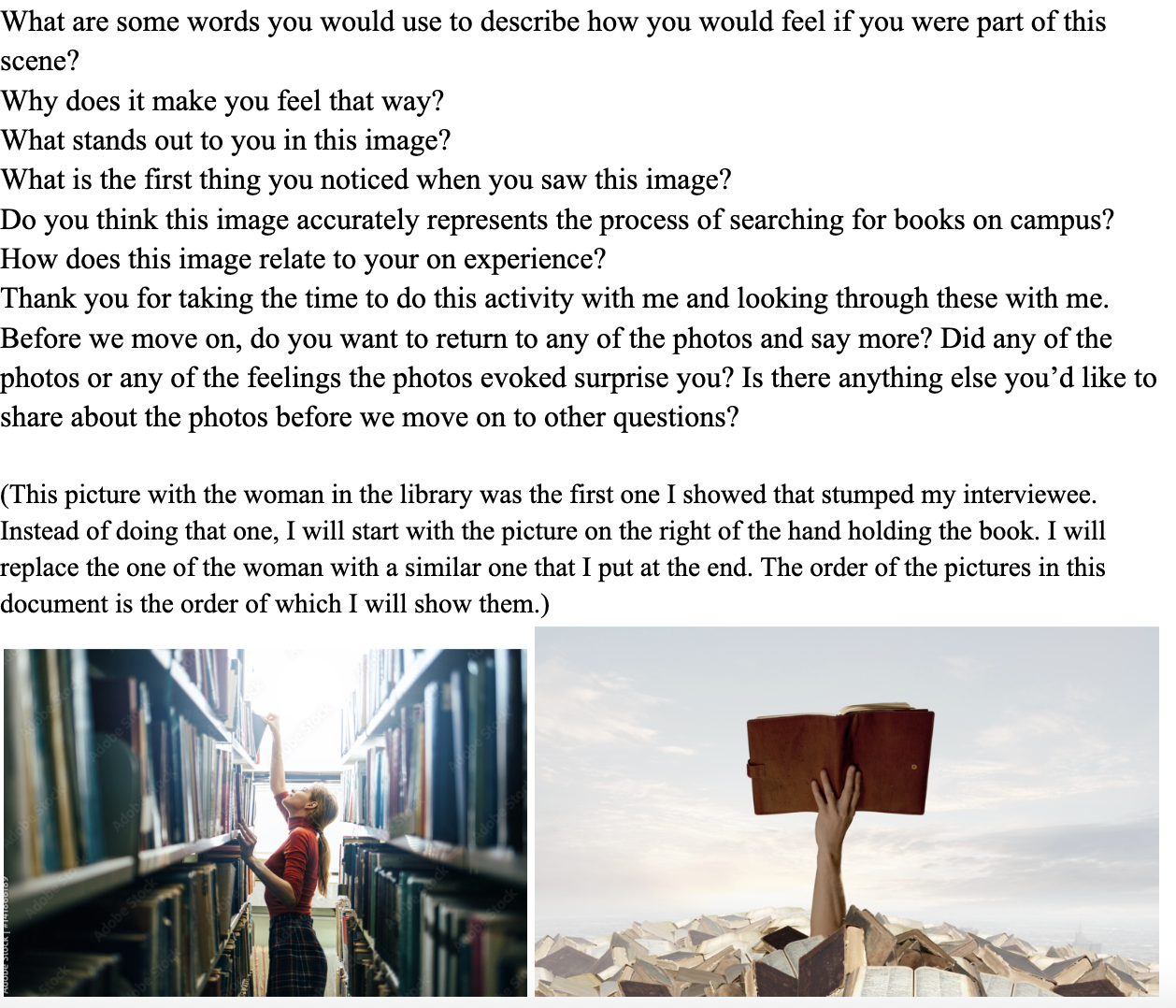
I selected photo elicitation as an activity to prompt deeper, more personal responses. Participants viewed a set of library-related images and discussed which photos reflected their own experiences or frustrations. After my first pilot interview, I refined both the question set and the photo selection based on the participant’s reactions, improving the flow and depth of responses. The phrases I bolded or put in parentheses are the aspects of the interview that I changed after my pilot interview. I also changed the types of photos I used based on how the pilot interview responded to them.
Conducting Interviews
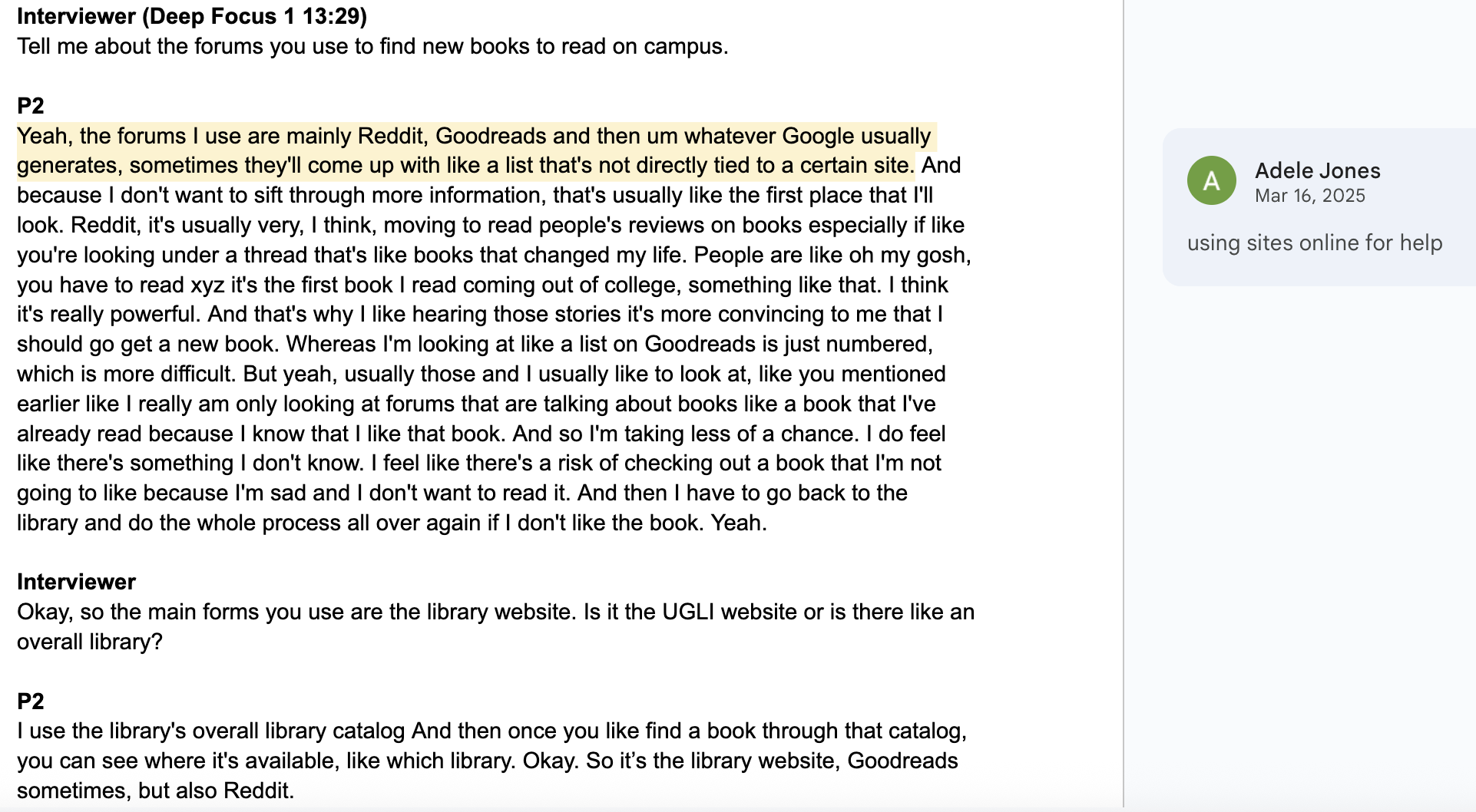
I interviewed five students, each for around 30-45 minutes, using my revised guide. All sessions were recorded and transcribed for accuracy. By keeping the structure consistent but allowing for follow-up questions, I captured both shared themes and unique perspectives about finding, using, and navigating library spaces.
Analysis and Deliverables
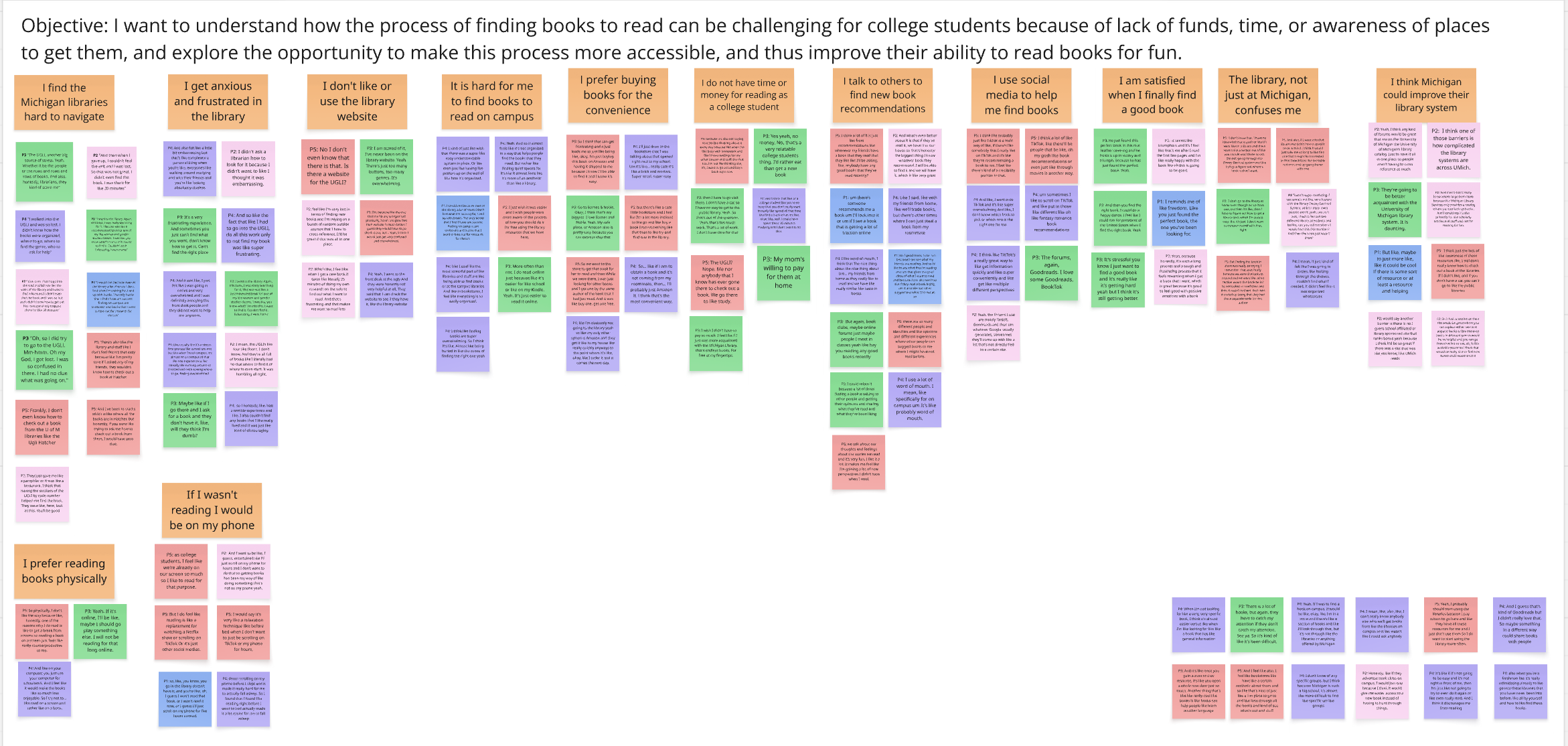
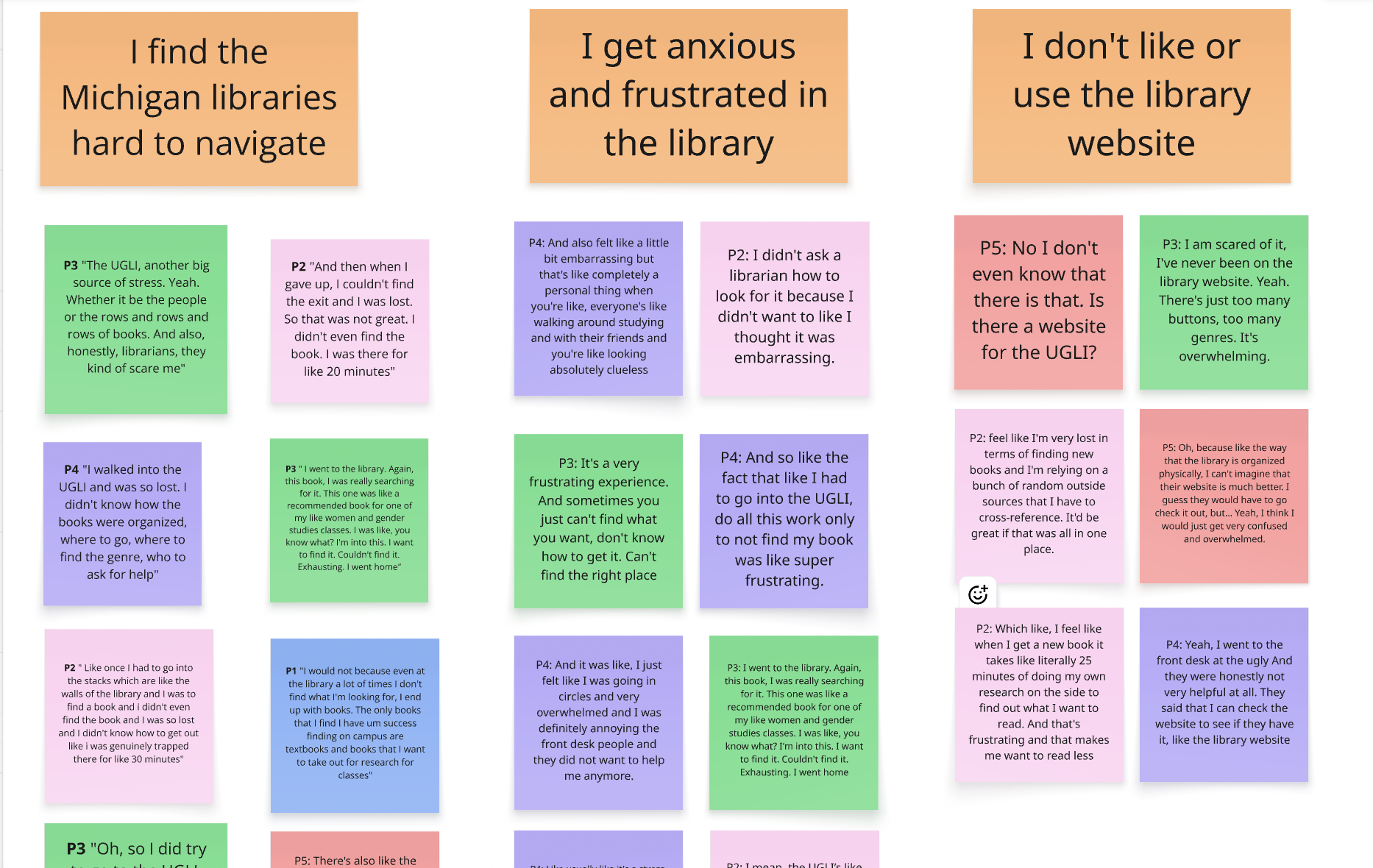
I coded each transcript in Miro, grouping quotes and observations into themes. From these patterns, I identified key insights about how students locate books, study, and navigate the physical and digital library environment. The themes I found included:
I find the Michigan libraries hard to navigate
I get anxious and frustrated in the library
I don't like or use the library website
It is hard for me to find books to read on campus
I prefer buying books for the convenience
I do not have time or money for reading as a college student
I talk to others to find new book recommendations
I use social media to help me find books
I am satisfied when I finally find a good book
The library, not just at Michigan, confuses me
I think Michigan could improve their library system
I prefer reading books physically
If I wasn't reading I would be on my phone
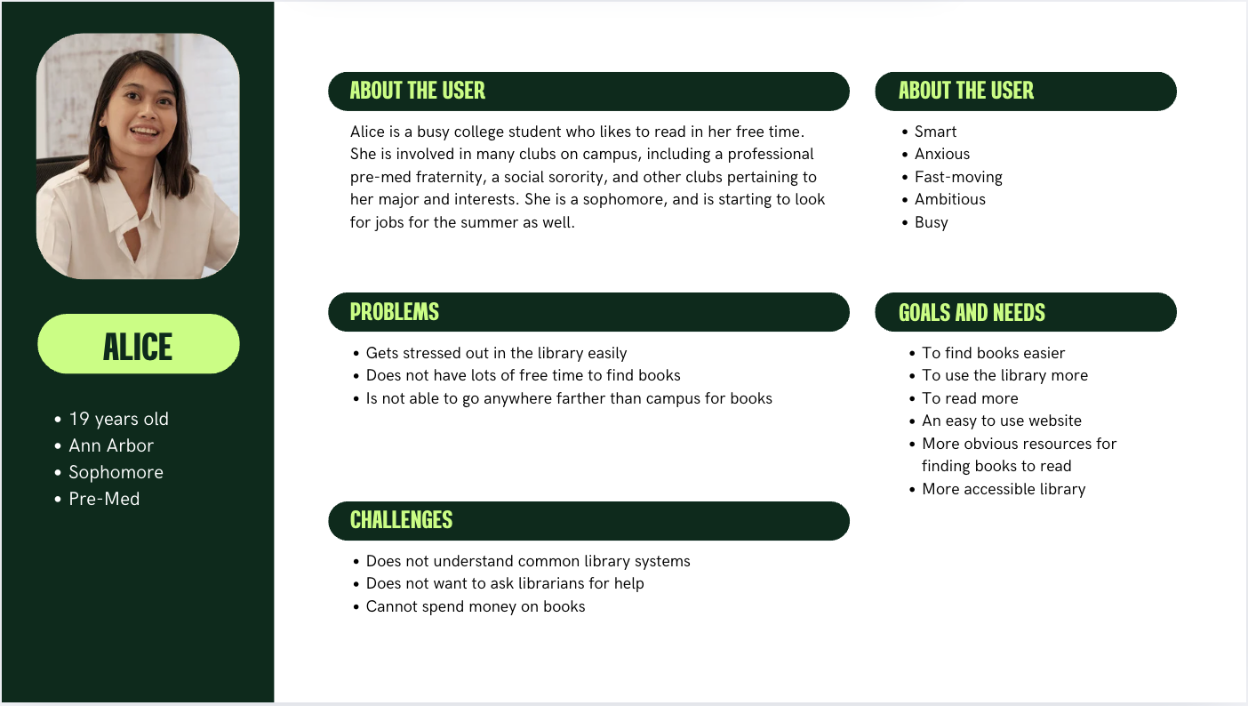
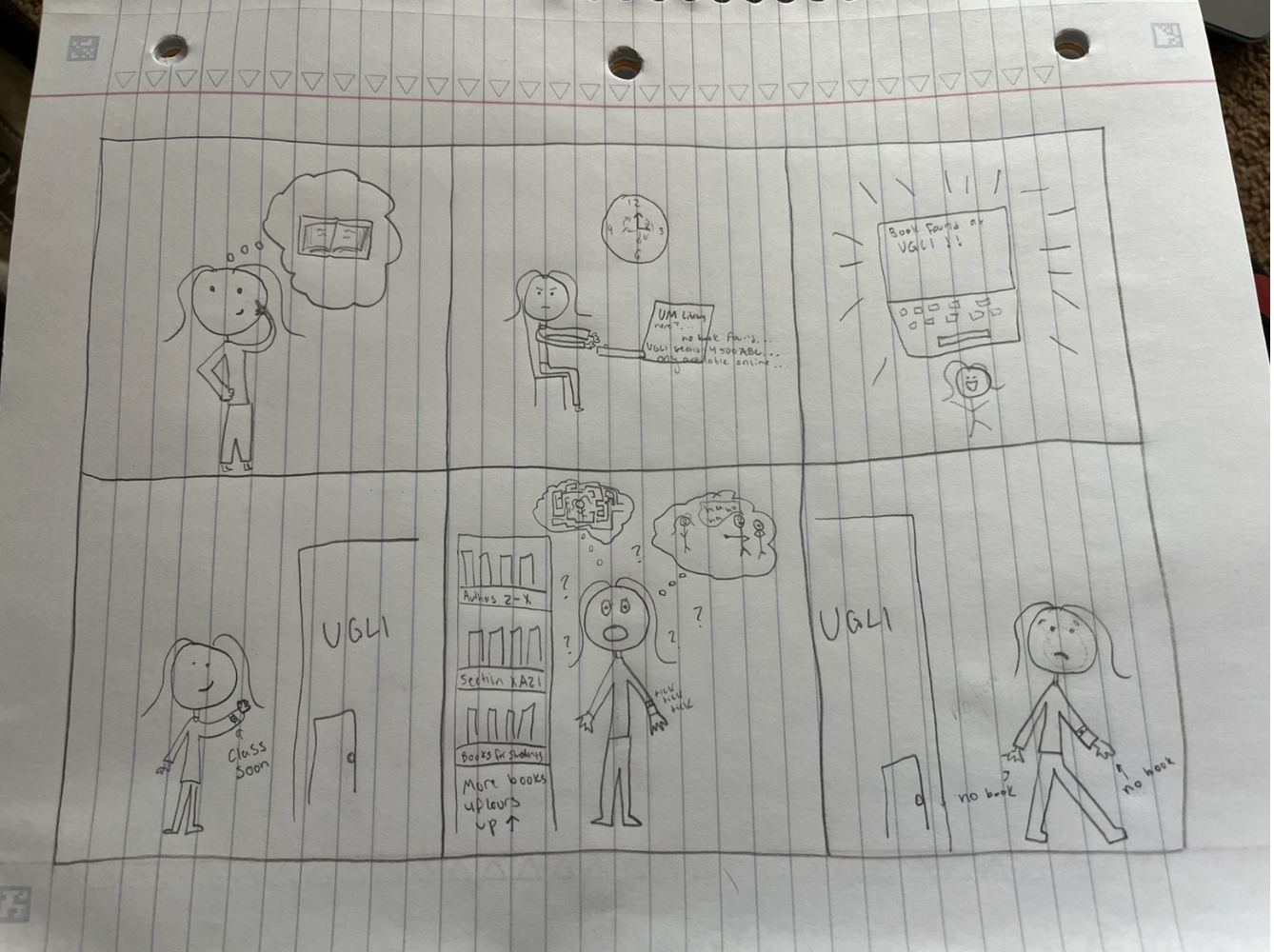
I then synthesized this information into a persona representing the common motivations and frustrations students experience, and a storyboard illustrating a typical interaction with the library system.
Insights & Next Steps
Reflection
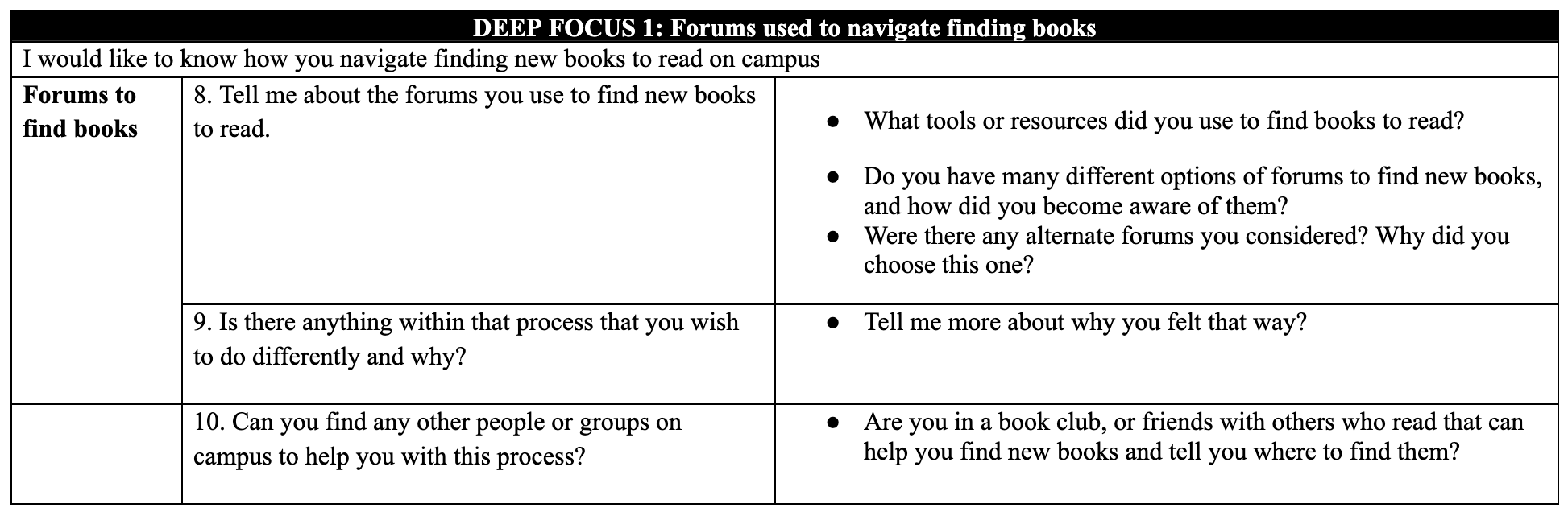
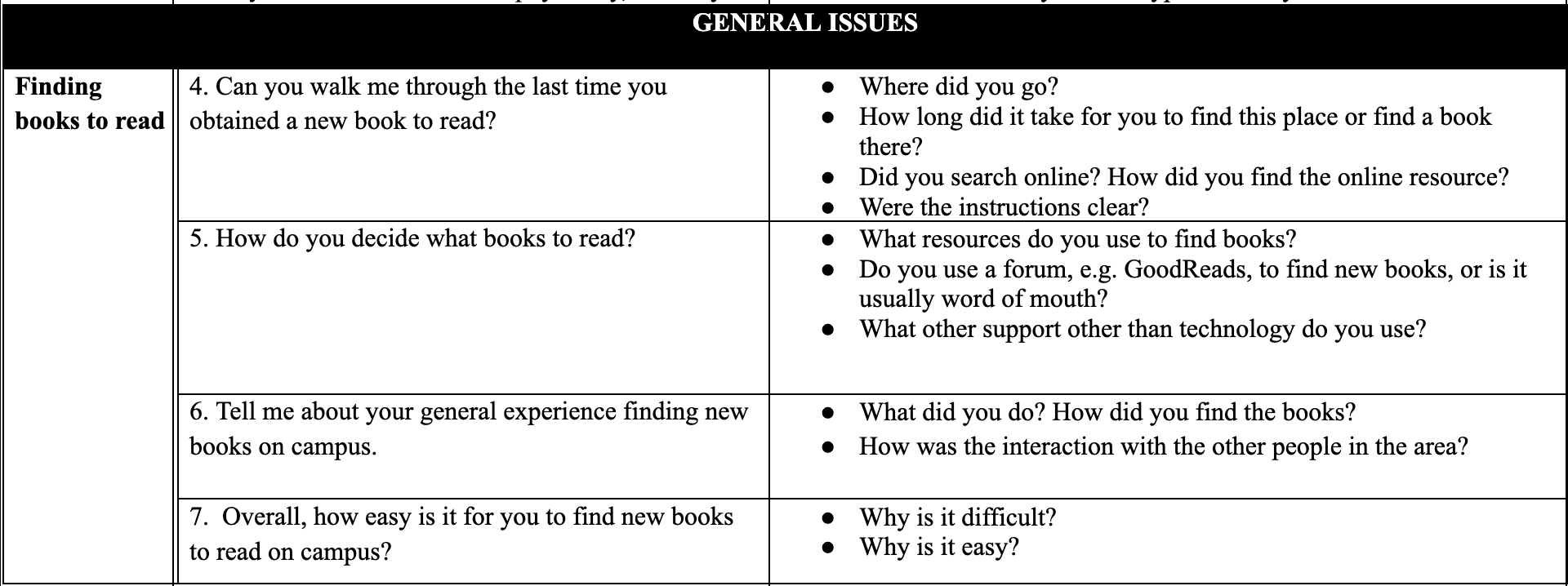
This research revealed that students value the library as a study space but often struggle with wayfinding, locating books efficiently, and understanding digital resource systems. Many participants expressed a desire for clearer signage, better mobile integration, and real-time study space availability.
As a next step, I plan to develop a suggested design solution informed by these findings, such as an improved digital navigation tool or an interactive map, to address the challenges surfaced during interviews.
Conducting this project strengthened my qualitative research and synthesis skills. I learned how to guide open-ended interviews, analyze large amounts of data systematically, and translate insights into actionable themes. Most importantly, I learned the value of iteration, like refining questions and activities based on early feedback led to more meaningful and authentic responses.